
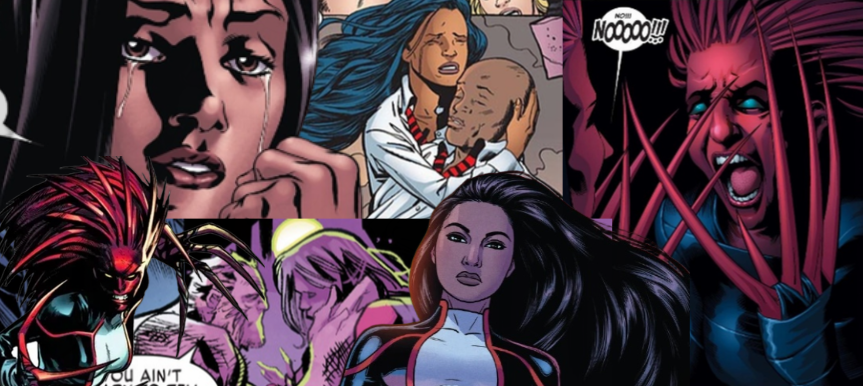
In the vast landscape of Marvel Comics, few characters embody the tension between brilliance and brokenness as fully as Monet St. Croix (M). Introduced in Generation X #1 (Lobdell & Bachalo, 1994), Monet’s journey has consistently been framed through the lens of trauma, perfectionism, and the quest for identity. At once the most confident member of her peers and the most haunted, Monet represents the paradox of outward control masking inner fracture.
As an educator, counselor, and philosopher, I find Monet an ideal case study in how fiction explores human struggles. Her story echoes psychological realities for marginalized groups—immigrant families, women of color, and survivors of trauma—while simultaneously engaging with philosophical questions about the nature of selfhood, authenticity, and freedom.
Origins and Early Trauma: Generation X
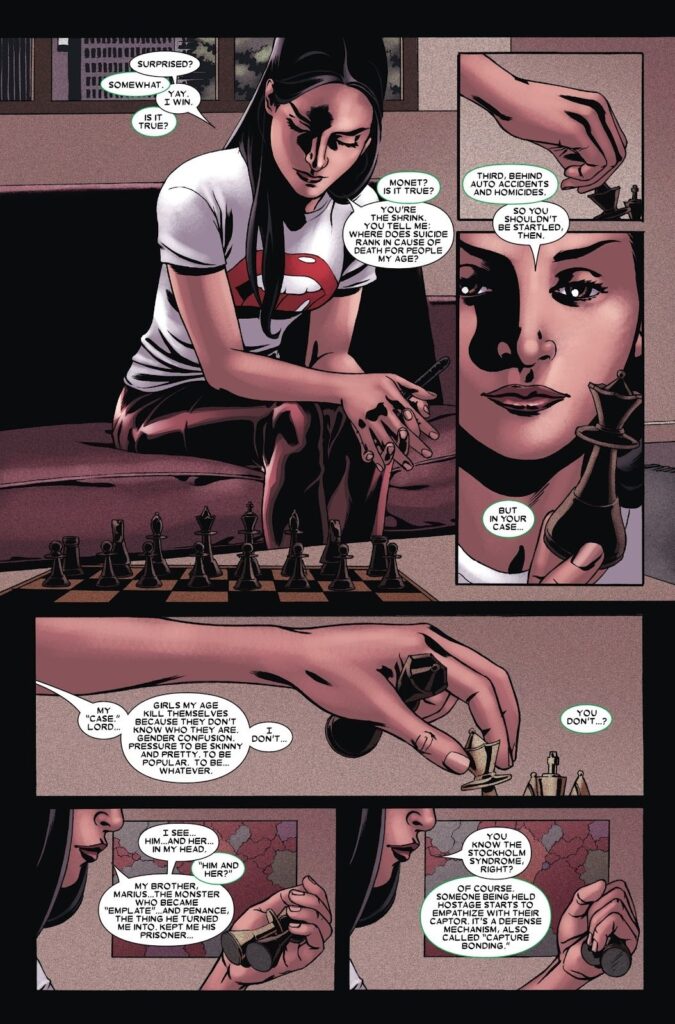
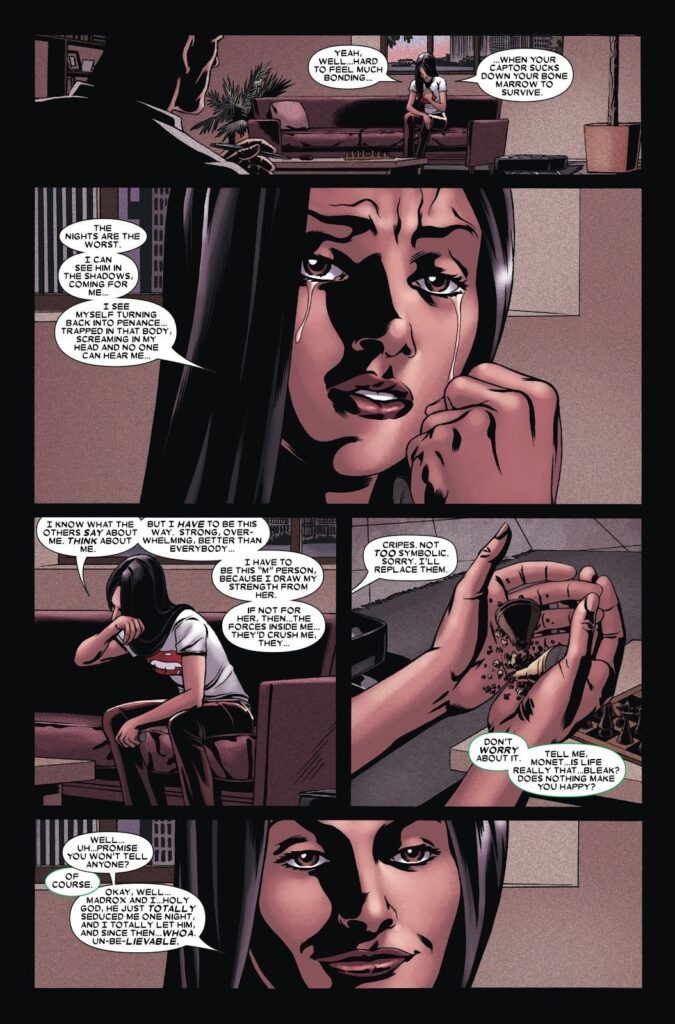
Monet’s early appearances in Generation X framed her as aloof, beautiful, and nearly perfect. Yet perfection masked deep wounds. Her abusive brother, Emplate, literally feeds on mutant life energy, and in one storyline imprisons Monet in the mute, crimson-skinned body of Penance (Generation X #3–#25). During this period, Monet’s identity is erased, her body used as a vessel, and her voice stolen. This early trauma sets the foundation for her later guardedness.

This entrapment can be read psychologically as symbolic of dissociation: the splitting of self to survive unbearable circumstances (Herman, 1992). Philosophically, it resonates with Fanon’s (1967) notion of the “fractured self” in colonized individuals: one’s body and dignity alienated by oppressive structures. For Monet, the polished perfection she projects after regaining her body may be understood as a compensatory mask, hiding fragility.
The Emergence of the Adult Voice: X-Factor Investigations
Monet’s most definitive growth appears in Peter David’s X-Factor run (2005–2013). Here she emerges as witty, biting, and brutally honest. In X-Factor #15, she famously quips, “I’m not rude. I’m honest. You’re just sensitive” (David & Raimondi, 2007). Her sarcasm functions as both armor and authenticity, allowing her to control how others perceive her.
Counseling frameworks suggest such strategies reflect trauma-adapted survival skills. Survivors often cultivate hyper-competence, emotional detachment, or defensive wit to avoid vulnerability (American Psychological Association [APA], 2013). Monet embodies these patterns—appearing invulnerable while internally carrying deep scars.
Her interactions with teammates, particularly Siryn and Madrox, reveal a recurring push-pull dynamic. She both seeks intimacy and recoils from it, echoing avoidant attachment theory (Mikulincer & Shaver, 2016). When Siryn experiences grief over her father’s death, Monet comforts her but quickly masks her own emotion, stating, “Don’t get used to it. Sympathy’s not my strong suit” (X-Factor #26).
Romantic Choices and Trauma Echoes
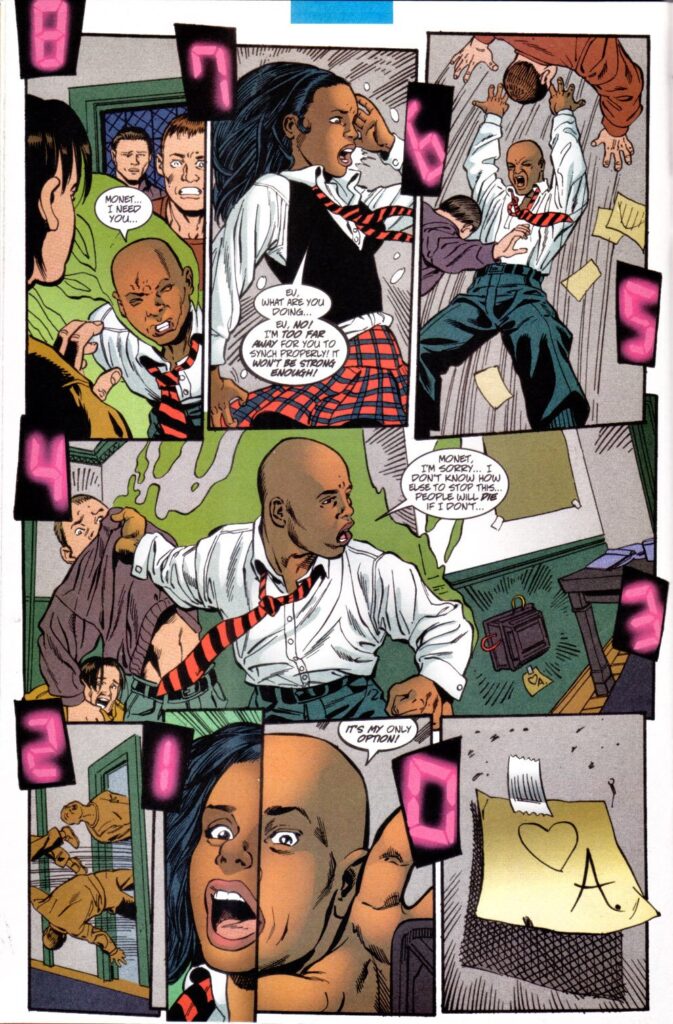
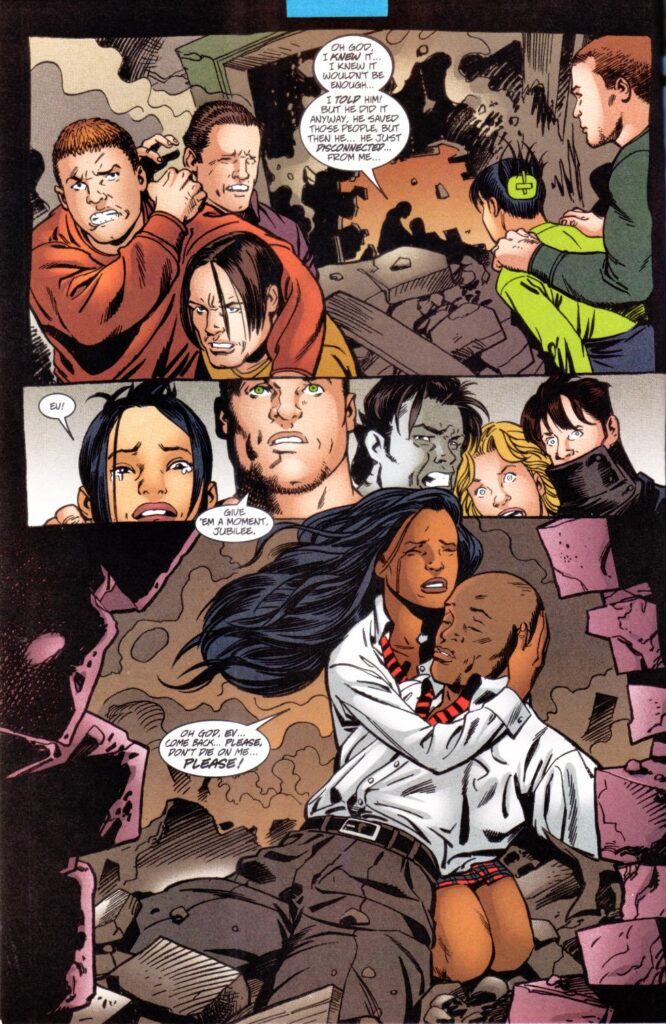
Monet’s romantic history offers a rich site for psychological analysis. While her perfectionism often kept others at a distance, her bonds reveal both vulnerability and the long shadow of trauma. One of the most defining relationships was with Synch (Everett Thomas), her fellow Generation X teammate. Their deepening bond symbolized hope and healing for both, culminating in Synch dying in Monet’s arms—confessing his love as she held him (Generation X #70, 2000). Clinically, the experience maps onto trauma-linked attachment patterns: proximity becomes paired with threat, so intimacy can trigger avoidance (Mikulincer & Shaver, 2016). That pattern subtly resurfaces after Synch’s resurrection in the Krakoan era: while other former Gen X classmates embraced Everett openly, Monet is depicted watching from a distance—present yet withholding (Hickman & Silva, 2019–2021; Duggan & Larraz, 2021–2022). The staging reads like grief’s muscle memory: proximity risks re-injury, so she chooses control through restraint. This is not indifference; it’s a survivor’s calculus.
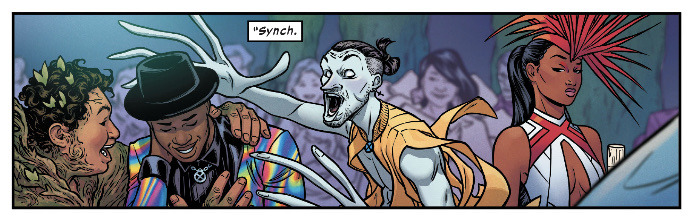
During her X-Factor years, Monet’s relationships became even more psychologically layered. With Multiple Man (Jamie Madrox), she was drawn to his fractured selfhood, perhaps seeing a reflection of her own divided identity. Their interactions were marked by ambivalence—attraction complicated by his multiplicity, which symbolized instability (David, 2005–2013). Her brief connection with Strong Guy (Guido Carosella) likewise showcased a recurring dynamic: Monet is often attracted to men whose obvious fractures echo her own internalized contradictions.
Her romance with Sabretooth is the most counterintuitive—and revealing. The AXIS inversion temporarily flipped moral polarities, leaving Victor Creed “good” (Remender, 2014–2015). In that interregnum, Monet’s attraction to Sabretooth no longer looked like the lure of danger; it looked like a wager on change. When their Uncanny X-Men team later disbanded, Sabretooth chose to remain with Monet as she was being corrupted/consumed by her brother Emplate—watching over her as others peeled away (Bunn & Land, 2016–2017). That choice reframes their dynamic: not only intensity, but care; not only predation, but protection. The pairing becomes a clinical case of “corrective relational experience,” in which a previously threatening attachment figure acts as a stabilizing presence during psychic crisis (Herman, 1992).

Monet has also flirted with Quicksilver, whose arrogance and velocity mirror her own intensity; those sparks underscore a pattern of attraction toward powerful, volatile men (Hudlin & Eaton, 2005–2006; and broader Avengers/X-Men crossovers). Taken together, her romantic history is less about fulfillment than about wrestling with unresolved wounds. Each partner echoes aspects of her fractured psyche—instability (Madrox), aggression (Sabretooth), or multiplicity (again Madrox)—and each bond becomes a rehearsal for integrating pain with agency.
Marginalization and Identity
Monet’s Algerian Muslim heritage is often underexplored in mainstream narratives, yet it situates her within multiple marginalized identities: woman, person of color, and religious minority in Western comics. This marginalization reflects the lived realities of intersectionality (Crenshaw, 1991).
In Generation X, her perfectionism may be read as a survival strategy familiar to many from marginalized groups: the pressure to be twice as good to be recognized as equal. Her control, elegance, and biting wit are not simply personality traits but forms of resistance against being diminished or stereotyped.
Modern Era: Krakoa and Beyond
The Krakoan era elevates Monet to prominence and—crucially—lets her integrate what once were split-off selves. Her capacity to shift by choice between M and Penance reframes what began as captivity and voicelessness into agency and fluency: rage and resilience (Penance) conversing with brilliance and poise (Monet). In clinical terms, it resembles trauma integration, where previously dissociated states are acknowledged and brought under conscious control (Herman, 1992). That interior synthesis clarifies why her response to Synch’s return is so restrained. In scenes where Everett reconnects with former Gen X teammates, Monet is positioned at the periphery—watchful, composed, not rushing into embrace (Hickman & Silva, 2019–2021; Duggan & Larraz, 2021–2022). Read alongside her past, the distance feels less like coldness and more like boundary-setting: a survivor honoring grief’s residue while refusing to be ruled by it.
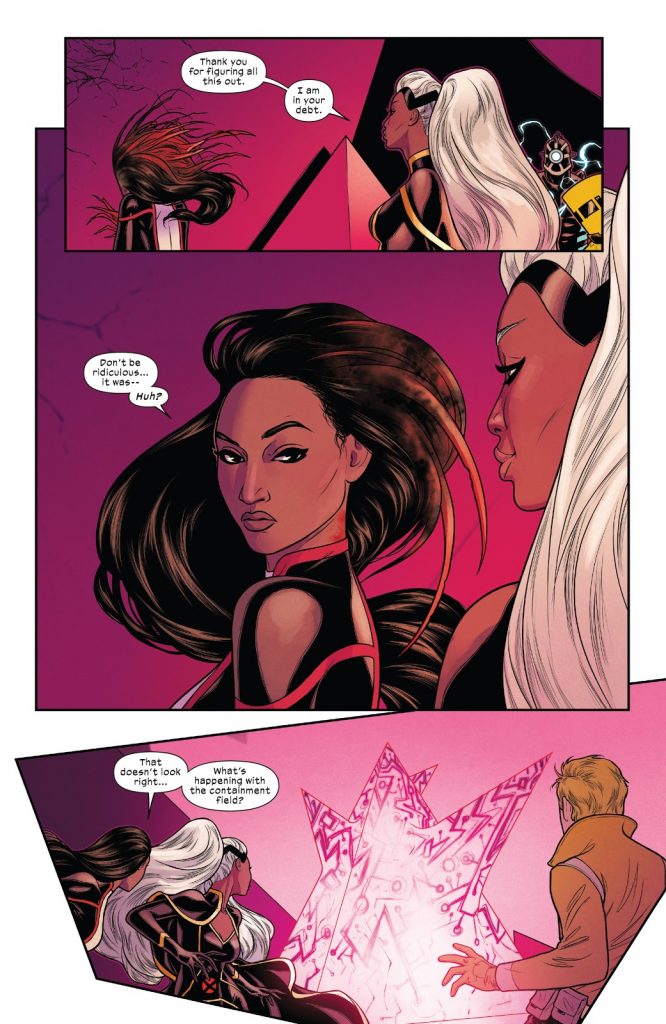
Politically and economically, Monet’s clout is unambiguous. As co-lead of X-Corp with Warren Worthington III, she steers corporate diplomacy and mutant-state enterprise (X-Corp #1–5; Howard & Alberto, 2021). On-field, she’s decisive and indispensable—at points acting to safeguard key leaders like Storm during high-stakes conflicts in the X-Men: Red era (Ayala & Reis, 2022–2023). Her choices with Sabretooth during and after the AXIS inversion, and his decision to remain when Emplate’s corruption isolated her, sit in productive tension with her public authority: a woman who commands boardrooms and battlefields can still accept being cared for—without being controlled.
In sum, Krakoa doesn’t “fix” Monet; it gives her a sovereign frame in which to practice integration: strategist and warrior, perfectionist and survivor, M and Penance. Her post-resurrection distance from Synch and her inverted-era bond with Sabretooth aren’t contradictions; they are coordinates on the same map—one charted by grief, boundaries, and a fiercely self-authored recovery.
Counseling and Philosophical Dimensions
From a counseling perspective, Monet St. Croix’s journey is a study in how trauma reverberates across identity, relationships, and the capacity for integration. Survivors often carry what Judith Herman (1992) calls “traumatic residues,” psychic imprints that shape attachment and coping long after the initial wound. Monet’s history exemplifies this: her childhood imprisonment as Penance, her family’s dysfunction, and her formative experiences with loss and betrayal all function as core traumas that echo through her adult choices.
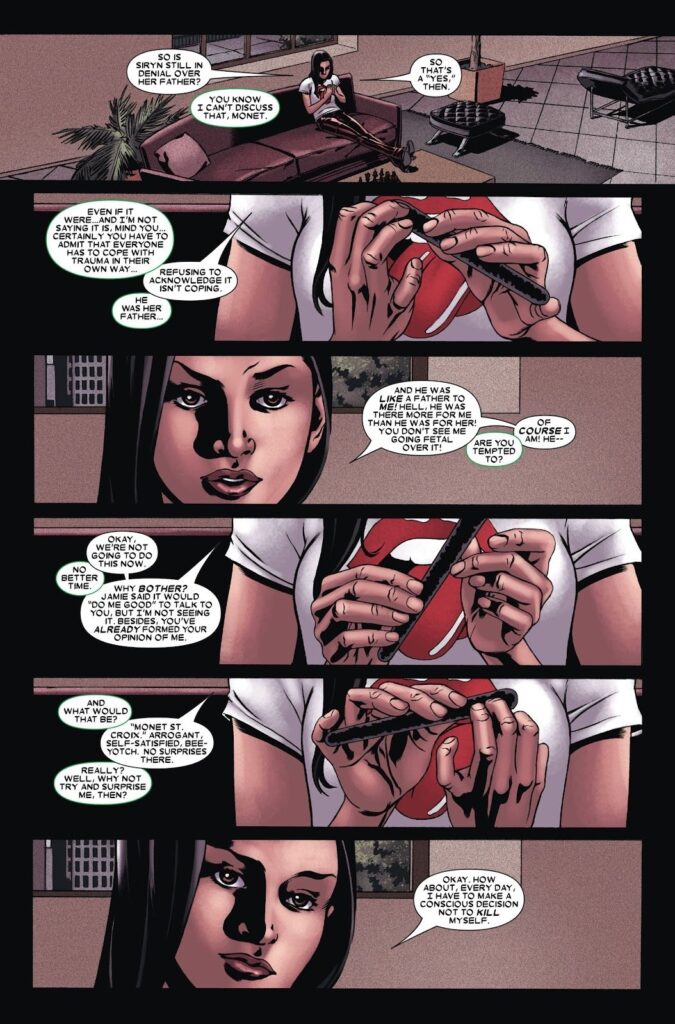
Her bond with Synch represents perhaps the most poignant instance of trauma-linked attachment. The intimacy they achieved in Generation X was cut short by Everett’s death in her arms—a moment that fused love with loss. In counseling terms, this creates what Mikulincer and Shaver (2016) describe as an “anxious-avoidant bind,” where intimacy is both deeply craved and deeply feared. This helps explain her Krakoan-era response to his resurrection: while others rushed to embrace him, Monet watched from a distance. Her restraint illustrates how survivors sometimes maintain emotional boundaries to guard against re-traumatization. Rather than indifference, this is a form of self-protection, a boundary drawn to manage grief’s lingering sting.
Her entanglement with Sabretooth highlights another therapeutic theme: the potential for “corrective relational experiences.” During the AXIS storyline, Victor Creed’s temporary moral inversion refigured him as capable of care rather than cruelty. When their Uncanny X-Men team disbanded, his choice to stay by Monet’s side as she was corrupted by her brother Emplate reframed their dynamic entirely—not predator and victim, but caregiver and companion. Counseling literature suggests that when a historically unsafe attachment figure behaves protectively, it can begin to rewrite internalized scripts of abandonment or danger (Herman, 1992). For Monet, Sabretooth’s presence complicates but also enriches her capacity to trust and accept support, even amid chaos.
Philosophically, Monet’s trajectory resonates with existential themes of identity and freedom. On Krakoa, her ability to shift at will between Penance and M is symbolic of what Kierkegaard called “synthesis”—the reconciliation of fragmented selves into an integrated whole. What began as punishment (being trapped in Penance form) is reclaimed as agency: she now chooses when to embody rage and when to embody composure. This mirrors trauma recovery as described in clinical contexts: not erasing wounds, but integrating them into a broader, self-authored narrative (Herman, 1992).
Moreover, her prominence as co-leader of X-Corp and her decisive field actions alongside Storm reflect the broader philosophical notion of “recognition” (Hegel, 1807/1977). To be recognized as both strategist and warrior affirms her full humanity, countering the marginalization she endured in earlier arcs. Her story, then, becomes not only one of survival but of transformation: trauma reframed as strength, fractured identities synthesized into wholeness, and relational wounds revisited as opportunities for new forms of trust.
Fractured but Beautiful…
Monet St. Croix remains one of Marvel’s most complex and underappreciated characters. Her journey—from traumatized girl to aloof perfectionist to reluctant leader—embodies the intersections of trauma, identity, and resilience. Older arcs such as Generation X and X-Factor laid the foundation for her psychological complexity, and her modern roles continue to reflect unresolved patterns.
For educators, counselors, and readers alike, Monet represents more than a superhero—she is a mirror of real psychological struggles and philosophical questions. Her story challenges us to consider how trauma shapes identity, how marginalized individuals navigate perfectionism, and how the quest for authenticity unfolds even amid fracture.
References / Further Reading
American Psychological Association. (2013). Diagnostic and statistical manual of mental disorders (5th ed.). Washington, DC: Author.
Boyle, K. (2017). Superheroes and identity: Critical essays. McFarland.
Crenshaw, K. (1991). Mapping the margins: Intersectionality, identity politics, and violence against women of color. Stanford Law Review, 43(6), 1241–1299.
Claremont, C., & Bachalo, C. (1994–2001). Generation X [Comic series]. Marvel Comics.
David, P. (Writer), & Raimondi, V. (Artist). (2007). X-Factor #15. Marvel Comics.
David, P. (Writer), & Various. (2005–2013). X-Factor Investigations. Marvel Comics.
Fanon, F. (1967). Black skin, white masks. New York: Grove Press.
Fawaz, R. (2016). The new mutants: Superheroes and the radical imagination of American comics. NYU Press.
Herman, J. (1992). Trauma and recovery: The aftermath of violence—from domestic abuse to political terror. Basic Books.
Hickman, J., Duggan, G., Howard, T., Ayala, V., & Percy, B. (2019–2022). Dawn of X / Krakoan era titles [Comic series]. Marvel Comics.
Lobdell, S. (Writer), & Bachalo, C. (Artist). (1994). Generation X #1. Marvel Comics.
Mikulincer, M., & Shaver, P. R. (2016). Attachment in adulthood: Structure, dynamics, and change (2nd ed.). New York: Guilford Press.
Mikulincer, M., & Shaver, P. R. (2016). Attachment in adulthood: Structure, dynamics, and change (2nd ed.). Guilford Press.
Pak, G., & Di Giandomenico, C. (2008). X-Men: Magneto—Testament. Marvel Comics.
Pak, G., & Land, G. (2010). X-Men: Legacy—Salvage. Marvel Comics.
Wells, Z., & Segovia, S. (2020–2021). Hellions [Comic series]. Marvel Comics.
Yampbell, C. (2005). Judging a book by its cover: Publishing trends in young adult literature. The Lion and the Unicorn, 29(3), 348–372.
Suggested Reading for Fans: Monet St. Croix’s Essential Storylines
1. Generation X (1994–2001)
Monet’s debut as part of the new teen team led by Banshee and Emma Frost. This run introduces her powers, complex personality, and begins to unravel the dark secrets of her family.
Collected in: Generation X Classic Vols. 1–2
2. X-Factor Investigations (2006–2013)
Reimagined as a sharp, witty detective in Peter David’s noir-inspired X-Factor. Here, Monet takes on major roles in storylines involving trauma, identity, and relationships (including Synch’s legacy, Madrox, and her connection with Darwin).
Collected in: X-Factor Vol. 1: The Longest Night
3. Uncanny X-Men: Axis & Beyond (2014–2016)
Monet’s dynamic with Sabretooth emerges during and after Axis, where moral alignments were inverted. This period explores their complicated relationship and Monet’s role on various X-teams.
Collected in: Uncanny X-Men Vol. 1: Superior
4. X-Men Blue (2017)
Though brief, Monet appears in her Penance form again, showing how Marvel writers continually revisit her struggles with trauma and duality.
Collected in: X-Men Blue Vol. 2: Toil and Trouble
5. Dawn of X / Krakoan Era (2019–2022)
Monet finally steps into leadership, shifting fluidly between Monet and Penance, and co-founding X-Corp with Warren Worthington. These stories highlight her evolution into a strategist and leader in mutant society.
👉 Collected in: X-Corp (2021)